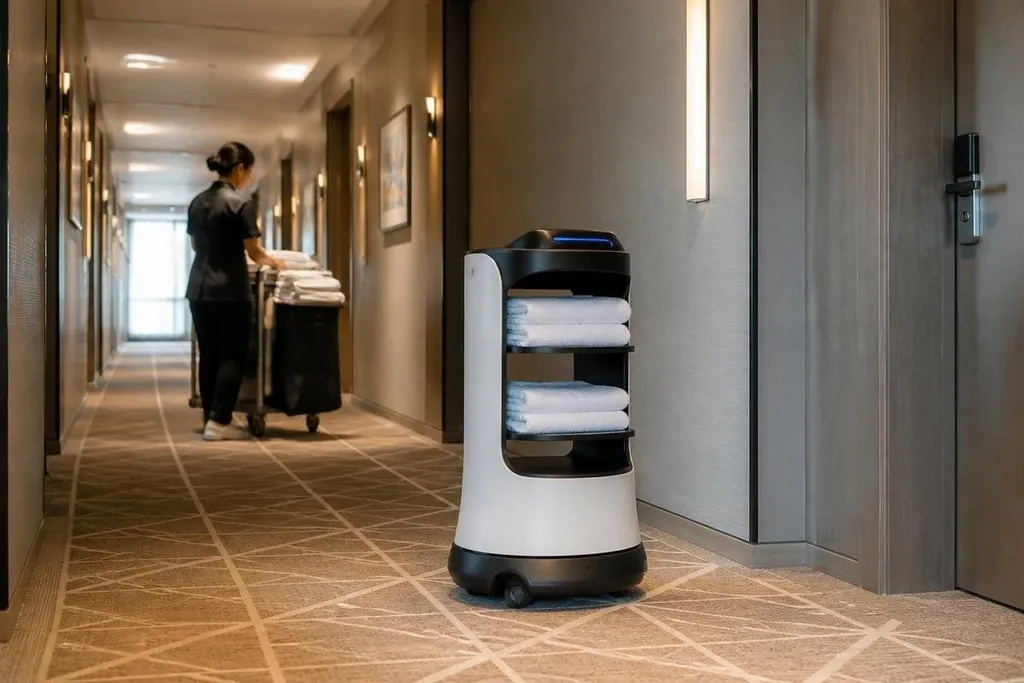
A hotel robot may spend its first useful years carrying towels, moving room-service trays, or cleaning floors after checkout. Guest-facing service will come later, because crowded lobbies and changing requests are harder for an autonomous system to handle.
This article looks at where hospitality robots are most likely to work, what they need to do it safely, and which limits still stand.
- Back-of-house work comes first: fixed routes and repeated loads are easier to automate.
- Guest service needs a person nearby: speech, judgment, and unusual requests still create problems.
- The purchase test is practical: a hotel needs to measure labor saved, service quality, and repair time.
Repeated routes are the best starting point
Hotels give robots a useful setting when the work repeats in the same place. A delivery robot could travel between a kitchen and a room-service floor, use an elevator, stop at a door, and return to a charging point.
That route still has hard parts. Doors may stay open, guests may block a hallway, and an elevator may arrive full. The robot needs cameras, LiDAR, and software that can stop when its path changes.
LiDAR measures distance by sending out laser pulses, so the robot can build a map of nearby walls and objects. The work also needs a clear handoff: a robot can carry a tray, but a staff member may still need to confirm the guest's room number or handle payment.
That division keeps the robot on a narrow task instead of asking it to manage the whole visit.
Room service is a stronger fit than the front desk
The front desk looks like an obvious place for a service robot. Guests ask about late checkout, local transport, room faults, and charges on the same shift. Those requests need context, and a wrong answer can create more work for staff.
Behind the front desk, a robot faces fewer changes. It could move linen carts between storage and floors, carry waste to a service area, or bring supplies to a cleaning team. Each job has a known load, a known route, and a person who can take over when the route fails.
The value depends on the building. A robot may work well in a new hotel with wide corridors and level floors, then struggle in an older property with steps, narrow doors, and soft carpet. The building becomes part of the robot purchase.
For hotel buyers, hospitality robotics reporting from Robot24.com can tie a robot’s route and staff handoff to the building where it ran. A machine that works in an empty corridor still has to move safely around guests.
The hard problem is safe movement around guests
Hotels change by the minute. A wedding can fill a corridor with people, a suitcase can block a lift, and a wet floor can alter a cleaning route. The robot needs to slow down, stop, and ask for help without turning a small delay into a service problem.
That means hotels will need clear rules before a trial begins. Staff should know who responds to an alert, where the robot may travel, and how workers can stop it. A visible emergency stop and a simple manual mode matter more than a polished screen.
Privacy adds another limit. Cameras used for mapping can also see guests, room doors, and staff activity. The hotel must decide what the robot stores, how long it keeps that data, and who can access it. Those choices belong in the purchase plan, not after installation.
What remains unproven
The largest question is not whether a robot can complete one delivery. It is whether the robot can repeat that delivery across busy shifts, recover from blocked routes, and keep working when a lift or door system changes.
A hotel also needs the full cost. That includes the robot, charging equipment, software, staff training, repairs, and the time a worker spends helping it. A machine that saves a few deliveries but needs constant resets may add work instead of removing it.
I’d start with one narrow route and a clear measure of success, then expand only after the robot works through busy periods without frequent staff help.
A practical buying checklist
Use these checks before a hospitality robot enters a hotel trial:
- Choose one task: name the load, route, handoff, and shift hours.
- Map the building: record doors, lifts, steps, floor surfaces, and public areas.
- Set a human fallback: assign a person who can respond to alerts and take control.
- Count the full cost: include service visits, software fees, training, and downtime.
- Protect guest data: define camera storage, access rights, and deletion rules.
- Set a stop point: pause the trial if staff help rises above the agreed limit.
The likely path is plain: hospitality robots will earn their place through repeated work in controlled areas, while people handle requests that vary by guest. The next useful measure won't be how friendly a robot sounds; it will be how many hotel tasks it completes without creating a new one.